
What drives digital transformation ROI on a Microsoft Dynamics 365 implementation
AEC and Manufacturing edition
Mathieu Lalagüe, Supply Chain Management Lead, ERP & Business Applications at Metam
Every Dynamics 365 pitch will have a digital transformation ROI slide. Faster close cycles, fewer manual touches, a number with a percent sign that makes the business case easy to sign off on. What almost none of those slides do is define ROI the same way twice.
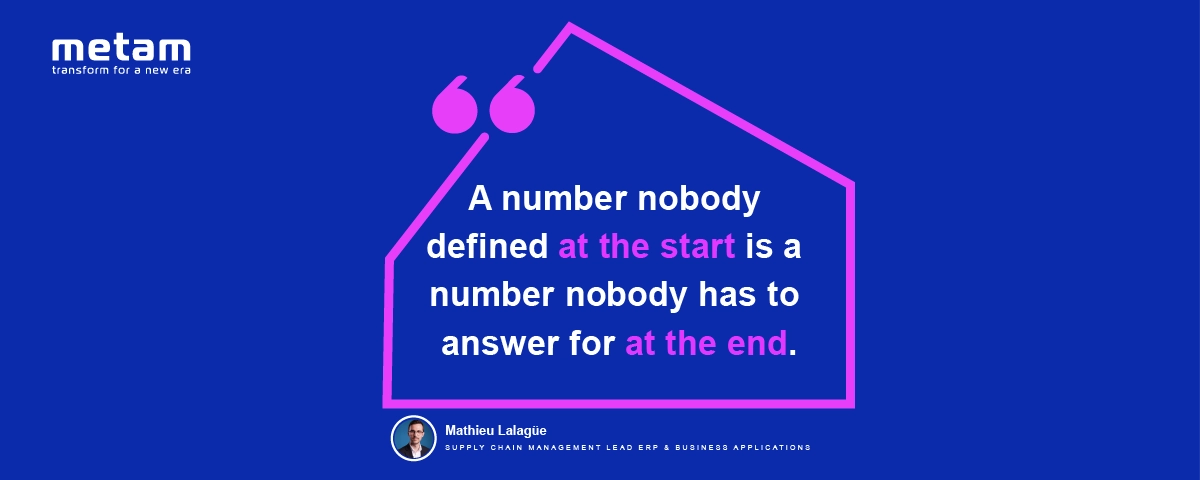
If you ask three vendors what ROI means on an implementation, you will get three answers. License savings. Headcount efficiency. Sometimes just a vague sense of “transformation” that nobody will be able to point to a year later. I do not think that looseness is an accident. A number nobody defined at the start is a number nobody has to answer for at the end.
Firms in AEC and manufacturing do not have room for that kind of vagueness. Margins are thin, projects run long, and a bad ERP decision shows up on the balance sheet for years, not quarters. If you are heading into Q4 planning with a D365 project already underway or still in the pipeline, pin down what digital transformation ROI actually means now. Not after go-live, when the numbers are harder to walk back.
The three digital transformation metrics actually worth measuring
Most of what gets labeled ROI on an ERP project is noise. Adoption metrics that do not tie to outcomes. Cost comparisons that ignore the operational baseline they are supposed to be measured against. Here is what is actually worth tracking, and why each one has a direct line to the business.
Measuring digital adoption speed. Not whether people are logging in, but how quickly teams drop the workarounds they built to survive the old system. In AEC, that shows up in how fast project managers stop keeping a shadow spreadsheet next to the ERP for budget tracking. The equivalent in manufacturing is how fast planners drop their spreadsheet next to the ERP for production and purchasing planning. Once that shadow spreadsheet disappears, adoption is real, not just reported.
Process time saved. Most firms measure this too narrowly, usually against one big milestone like project close. The real gain sits in the tasks that repeat every week: generating a WIP report, reconciling subcontractor billing, pulling numbers together for a leadership meeting. Time saved on frequent tasks compounds faster than time saved on any single big process.
Data accuracy improvement. Harder to quantify, easiest to underrate. If finance is still reconciling numbers across two systems six months after go-live, the accuracy gain promised at the outset has not shown up, whatever the adoption dashboard says.
These three, together, are the closest thing to a real digital transformation ROI signal on a Dynamics 365 project. Everything else is a proxy for one of them.
Where firms measure ROI at the wrong time
There are two failure points, and they sit at opposite ends of the timeline.
Measure too early, right after go-live, and you capture nothing but disruption. New systems slow teams down before they speed them up. I have seen firms panic over an early dip and make changes that undercut the implementation before it has had a chance to settle.
Measure too late, a year in, and the baseline has already drifted. Teams quietly build new workarounds around whatever gaps remain, and it becomes hard to separate what the ERP delivered from what simply changed in the business over twelve months. A year is long enough to absorb inefficiency without anyone noticing.
The window that actually tells you something is the first two to three full project cycles after go-live, whatever that looks like for your business. Long enough for adoption to stabilize. Short enough that the comparison to your pre-implementation baseline still holds.
A short checklist for this quarter
Before the next planning cycle finalizes, run through this:
- Do we have a documented baseline for adoption, process time, and data accuracy from before implementation began?
- Have we assigned clear ownership for digital transformation ROI tracking post go-live?
- Are we measuring in the window that reflects stabilized use, not the first weeks or the one-year mark?
- Are the metrics we are tracking tied to actual business outcomes, not just system usage?
- Does our reporting cadence match how the business actually operates, not how the software reports by default?
None of this needs new tooling or a bigger budget. It needs a firm to be specific about what digital transformation ROI means before the project starts, and disciplined about measuring it at the right time once it does. That is the part most D365 pitches skip past, and it is the part that decides whether the ROI slide from the deck ever becomes a real number.
Is your Microsoft D365 implementation giving the return you expect?
30% of our Microsoft Dynamics 365 implementations started with another partner that had either stalled or failed to deliver value. Metam recovered these with a 100% success rate.